
5 Key Factors That Ensure a High Success Rate in Secure RAID Server Data Recovery

Introduction:
The most popular use for RAID systems is on servers for performance, capacity, and fault tolerance. Although there is some redundancy in RAID arrays, they are not foolproof.
Even if there is no hardware failure, if multiple drives crash, if there is a controller failure, if the data becomes logically corrupt, if the firmware fails or if data is accidentally deleted, critical business information could still become inaccessible.
In such instances, organizations need to secure RAID server data recovery with a high success rate to resume operations promptly and safely.
There are not equal recovery attempts. Recovering drives isn’t just about connecting drives to recovery software, there are a number of critical factors that can help you be successful.
Professional recovery includes top-tier knowledge, controlled surroundings, advanced tools, and stringent security measures.
The wrong course of action can result in loss of any remaining data or release of confidential information.
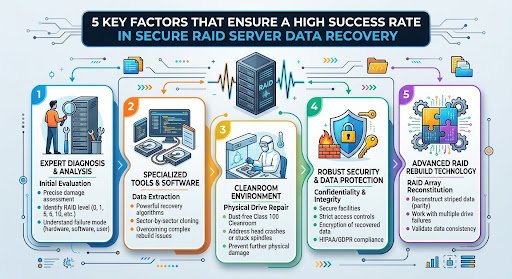
Listed below are the top five elements that play a great role in the recovery of data from a RAID server which is successful and secure.
When choosing a recovery partner, businesses can reduce the likelihood of the data being recovered by avoiding mistakes that can be expensive.
1. Specialized Expertise and Hands-On Experience with Complex RAID Configurations
Having a deep understanding of complex RAID configurations and hands-on experience with them.Having extensive knowledge and experience with complex RAID configurations.
The most crucial is the level of technical expertise.
There are a number of levels of RAID systems: RAID 0, RAID 1, RAID 5, RAID 6, RAID 10, RAID 50, RAID 60, and other combinations of the various RAID systems. Different kinds of striping, mirroring and parity methods are used at each level.
Most contemporary servers use RAID controllers and sophisticated firmware, hot spares, and multi-terabyte RAID arrays across several enclosures.
Frequent users of these locations know how to rebuild virtual disks, recover parity, and rebuild from multiple drive failures without destroying data.
They understand when automatic rebuild can exacerbate the situation and how to interact with failing controllers and/or incompatible firmware versions.
Experience also is important when facing mixed drive sizes, brand or partially degraded arrays. A high-level expert can determine the cause of failure in a short time, be it disk failure, missing or damaged metadata, or logical volume manager problems, and select the most secure method to recover.
On the other hand, general data recovery services that don’t have experience with RAID often try risky procedures that can reduce the chances of success.
The firms that need reliable RAID server data recovery and have a good success rate should focus on those that can boast a long record of successful recovery from enterprise-class arrays and that have certified engineers with a history of successful recoveries.
2. Advanced Test Technology and Proprietary Recovery Technology
Correct diagnosis is the key to a successful recovery. Experts need to carefully assess the health of each drive, the RAID controller and the array configuration before any data can be removed.
It takes the professionals and the tools that are beyond consumer grade to complete this process.
Techniques for creating safe working copies without putting additional strain on the original media include imaging equipment that can handle unstable or failing drives, and specialized RAID reconstruction software and equipment that can work on the sectors and specific blocks of the RAID.
Advanced platforms can also reverse-engineer proprietary RAID metadata, recover if one or more RAID card(s) fail, and mount encrypted volumes with proper authorization.
Physical repairs like replacing head stack or transferring platters are performed in a cleanroom facility in a modern recovery lab (Class 100 or better).
These controlled conditions will prevent contamination that would destroy remaining data. These tools, along with proprietary algorithms created specifically for complex RAID sets, dramatically increase the chances for file recovery that is not possible using standard tools.
Simple software tools can often lead to flawed or incomplete recovery. To ensure consistent high success rates, with data integrity throughout, professional technology is required, and must be applied correctly.
3. Comprehend risk assessment and pre-recovery evaluation
One of the biggest mistakes people make is to rush into recovery without first conducting a comprehensive evaluation.
To be able to make a proper assessment, it’s necessary to specify the exact RAID level and stripe size, number and order of the drives, to know if they have been rebuilt before and what the SMART data looks like, and to examine the physical media condition.
Careful documentation of the original configuration is also a task for technicians. Assuming that the drives are in the wrong order or that they are not in parity order can result in scrambled data for the rest of the life of the drive.
A detailed risk analysis is useful to determine if a logical recovery is appropriate, or if physical intervention is necessary.
A transparent provider will communicate the assessment results with the client prior to moving forward and inform the client the likelihood of success as well as risks involved. This helps to build trust and helps to make informed decisions.
The next step in the recovery process is much more accurate and far safer when the evaluation is comprehensive, which means there’s a direct link between the thoroughness of the evaluation and the higher rate of success in the recovery process.
Often, a lack of or rushed through this stage results in permanent damage. A systematic pre-recovery evaluation is an essential component of any professional RAID recovery, and it can’t be bypassed.
4. Strict Security Procedures and Chain of custody procedures
As important as technical success is the security of data. Server arrays can store valuable information, including financial information, customer data, and regulated data that needs to comply with laws and regulations like GDPR, HIPAA, or industry-specific.
Professional recovery services have the highest security measures in place starting from the moment that the drivers leave the client’s premises.
These include secure packaging and transport, documented chain-of-custody tracking, limited access to recovery facilities, encrypted temporary storage and strict non-disclosure agreements. There are various laboratories that have ISO certified data security management systems and are audited regularly.
Throughout the recovery procedure, the data may NOT be accessed by anyone who is not authorized to have access to it, or on insecure networks. Upon recovery, the original media and working copies are managed in accordance with the client’s retention/destruction wishes. Clients need to be provided with transparent reports of all security measures implemented.
These protections are necessary for even a technically successful recovery to not present significant compliance or reputational issues. Therefore, secure handling is an important aspect of a top-notch RAID recovery service.
5. Proven Methodology, Transparent Communication, and Post-Recovery Support
The implementation of a well-established methodology, clear communication, and post-recovery assistance.
Finally, it’s important to have a standardized, proven recovery plan in place and effective communication and assistance following data recovery. Leading players have standardised workflows that have been optimised from hundreds or thousands of previous cases. These processes reduce human errors and guarantee uniformity of results.
Clients should be updated throughout the engagement about progress and realistic timelines, as well as any unforeseen issues. Once recovered, the data needs to be checked to ensure that it is complete and accurate. A good service should offer a detailed recovery report and help the client put the recovered information back in the environment safely.
Continuous support like providing recommendations for future failure prevention, better backup strategy, or RAID best practices, adds value. Having a partner who views recovery as a process and not a singular and discrete technical task enhances the likelihood of success and outcome for the recovery.
Conclusion
It is not a lucky occurrence that RAID server data recovery can be achieved with a high success rate.
Requires specialized knowledge of a complex RAID system, advanced diagnostic and recovery tools, comprehensive pre-recovery evaluation, rigorous security and chain of custody procedures, and a well-tested approach supported by clear communication and follow-up recovery support.
In their presence, organizations can greatly increase their likelihood of safely and completely restoring critical data.
The absence of any of them increases the risk of permanent loss of data or compromise of security.
For businesses relying on RAID servers, it is important to assess the recovery provider with these factors in mind.
Only a well-qualified specialist who will consistently use all five factors will provide the greatest security for important data and provide the greatest base from which to continue operations after a serious storage failure.